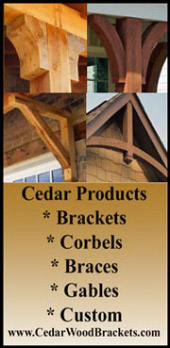
CEDAR INSTALLATION CEDAR GABLES **Our decorative gables should NEVER be used structurally as a load bearing or structural truss***. Installing our gables can be done a variety of ways and is very dependent on the situation. Typically these are installed in the gable roof line. If the roofline is closed up and the hidden 2x4s within the roofline are not visible then it is recommended you purchase the mounting boards with our gables. The mounting boards are 2x4s that “frame” the gable out on the outside connecting the spokes and completing the triangle. You would then locate the 2x4s hidden in the roofline and pass timberlok lag screws through the mounting boards and into these 2x4s in the roof line to hold the decorative gable accent piece. Mounting boards can also be added by the customer themselves by purchasing their own 2x4s locally. Depending on the size of the gable you might use 4 of the timberloks on a 66” gable or 6 of these on a 92” gable. If the roofline is not already closed up then you can pre-install blocking in the roofline before closing it up and order a gable without a mounting board. Some people don’t like to see the mounting board so this is a route you can go if the roofline is not already closed up. Pre install wooden blocking everywhere so that when you get the gable you can drill long 6-8” timberloks through the spokes and into the wood blocking. Always consult and defer to a local handyman/contractors knowledge to assist you in installing our cedar gables since every situation is slightly different and gable peaks can be framed differently from one home to the next.
MEASURING ROOF PITCHCon
sider hiring a professional handyman or contractor to measure
your roof pitch on site. Use of a plumb bob and a level is likely needed to accurately measure the pitch of a roof. PDF pitch charts are available by email request but only give a rough idea of pitch and should not be used to determine actual pitch.
NOTE: If used outdoors we recommend sealing the wood to minimize the chance of it cracking over time. Sealing with oil-based paints (not latex), stain, or clear sealant is preferred. Large timbers can be subjected to small cracks over time nonetheless up to 1/16” wide without compromising the product.